“Each time she said the word me there was a gathering in her like power, like joy, like fear.”
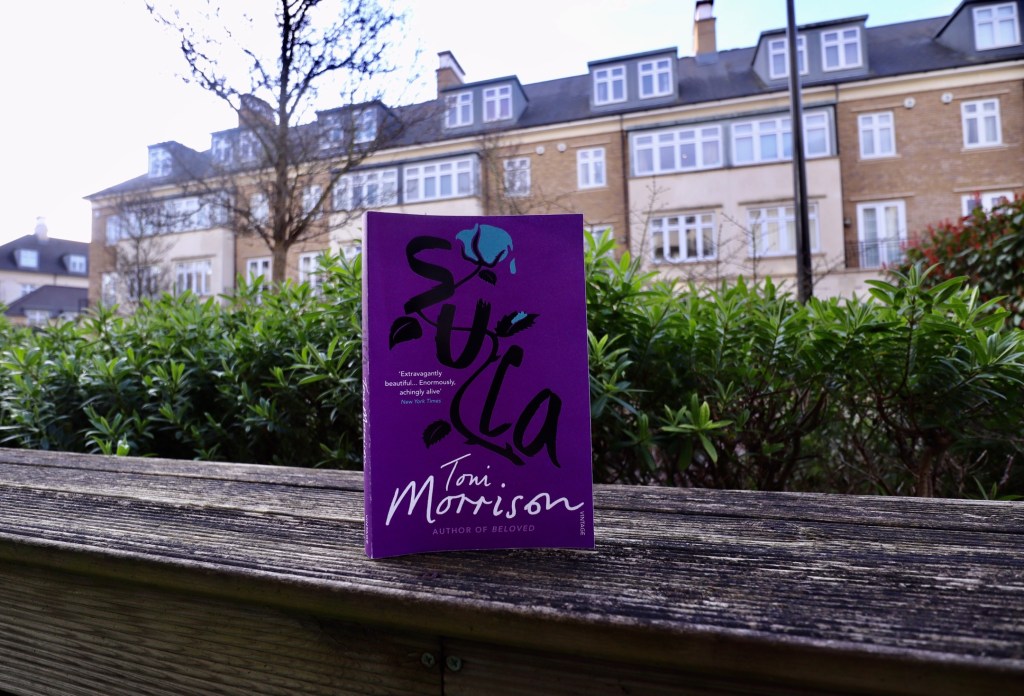
The question of freedom has always been an interesting one for me. Maybe it’s because I come from a country where Freedom only became a reality for people like me 27 years ago. Or maybe it’s because even with that I realised that being a woman and African meant that freedom might just be an elusive concept for me. However, even with that understanding, I have always been wildly interested in the notion of freedom and complete autonomy over myself. I have spent many nights and many days ruminating over what it means to be free and how it that freedom manifests in various places in our lives. Sula by Toni Morrison is a book that explores this very concept of freedom and how it intersects at a crossroads of Blackness and Womanhood.
Sula was first published in 1973 and is Toni Morrison’s second published novel. Anyone who has read Toni Morrison will tell you that she does not write for half-hearted readers. She writes for people who are willing to get down in the trenches with her. People who are willing to ask the writer questions and aren’t scared to have those same questions pointed right back at them. That is the beauty of Toni Morrison, she requires your full attention before, during and after you read her work.
“Because each of them had discovered yers before that they were neither white nor male, and that all freedom and triumph was forbidden for them, they had set about creating something else to be.”
In Sula we follow the life of a woman who Toni Morrison referred to as “whimsical and who follows her own instincts”. We meet Sula and her best friend Nel as they grow up, find each other and create a home for one another within each other. We follow their lives and the lives’ of the women who shape them. We read along as Sula and Nel become too different in their views and in their womanhood. Nel lives a life that is seen as typical by many standards; married with children and living in her hometown. Sula follows a path of independence going off to college only to return to her little town completely belonging to herself.
Toni Morrison does such a great job at exploring the different manifestations of what it means to be free, Black and a woman in the United States from the 1920s to the 1960s. We experience freedom through the Peace women who are not bound to anyone other than each other which is in itself is another type of confinement. Our understanding of freedom is further stretched when Sula dismisses familial obligations by severing ties with her own family but also by bringing into question the foundations of Nel’s family and the families of other women in the small town of Medallion. We see people act a certain way in her presence. In Sula, Toni Morrison really does the work of expanding the readers understanding of community; how our communities label us and how we then live out our lives as a result of that labelling. I found myself questioning the very notion and function of community, can any of us live out our freewill if we are really set in places that expect us to tick certain boxes in order to earn being a part of something and of belonging to some people. Sula is a great book for questioning and I enjoyed the pacing of the book. It seemed to pause just when I need a break and throw me back into the story when I was ready to dive back in.
“Yes. But my lonely is mine. Now your lonely is somebody else’s. Made by somebody else and handed to you. Ain’t that something? A second handed lonely.”
One of the things I love about Toni Morrison’s work is that she does not write good and bad characters. I don’t think it is ever clear when leaving her work who is the good, the bad nor the ugly. You walk away with questions. Questions about what you see as good and questions about the lenses that you have been provided with that allow you to see certain things as bad and only attributable to bad people. I enjoyed this tone in Sula. I enjoyed the curiosity I held throughout the book about whose side I was supposed to be on and in the end I came to the realisation that the imperfect characters were by design. That not knowing is intentional because it is mirror of life, of the unknowingness of whether you are good or bad and then falling to an understanding that you are neither.
Sula is definitely a book for the ages that will need to be read over and over to fully uncover the messages in the book. There are some things that I am still unsure about but I am one hundred percent sure that it will be a book that I read over and over again. If you haven’t read it I would highly recommend that you pick it up.
 Nthabi And Her Books